

The Abundance
On beautiful food and who gets to eat it

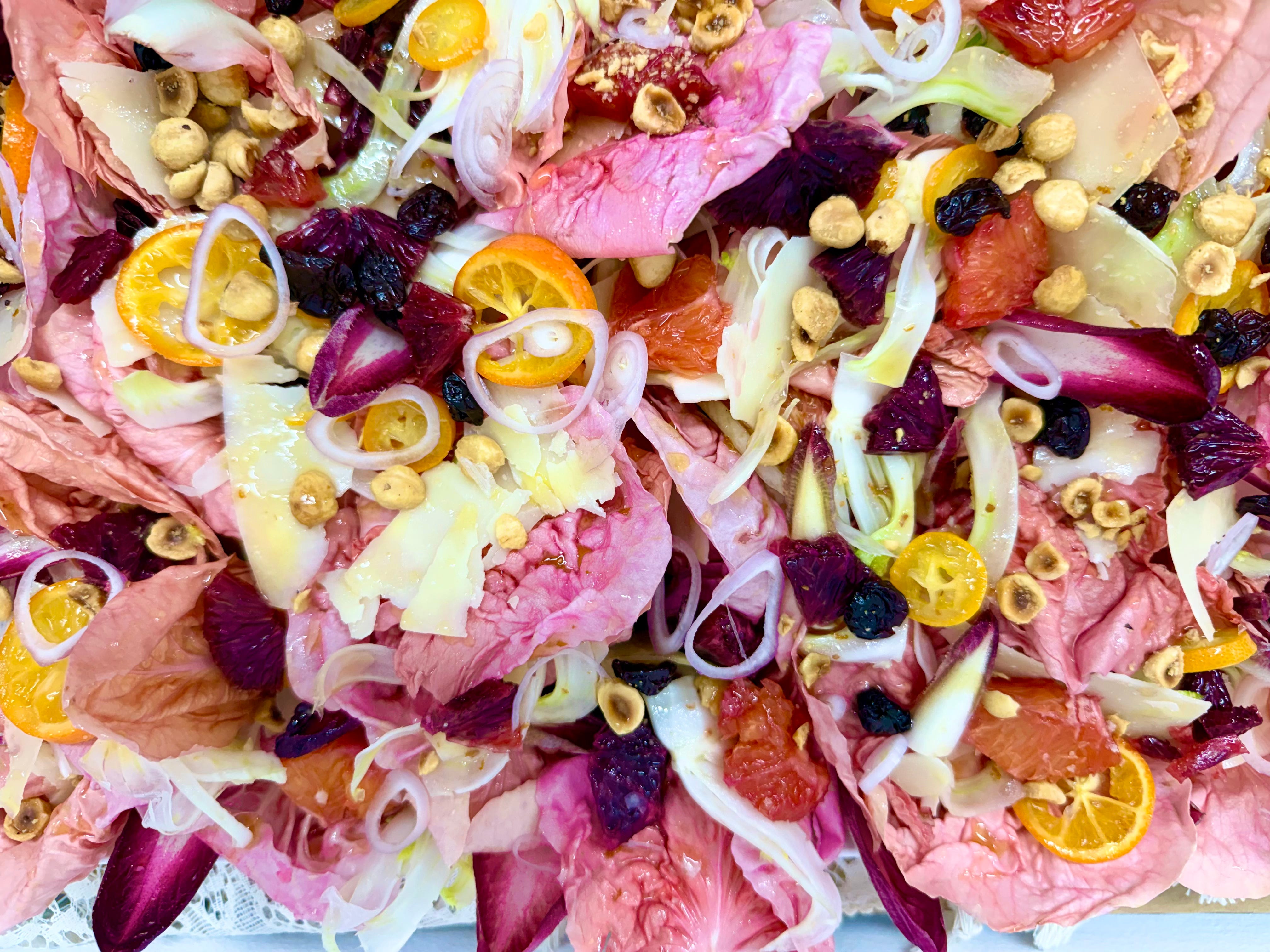
I catered a dinner party last month for ten women…art dealers, curators, media. The stakes were high, and the food needed to be visually beautiful, but I also knew these were women eating at 7pm, talking and catching up on the agenda, and they weren’t going to eat a ton.
So I chose to go minimal, but beautiful. For the main event, a study in emerging spring colors: pink radicchio salad with blood oranges, hazelnuts, and thinly sliced fennel, alongside a winter Niçoise—confit tuna that shredded delicate and tender, jammy eggs dyed with beet juice, delicata squash, beets, green beans, olives.
Throughout the dinner, they talked, they ate, they grazed, and at the end of the night, I went home with very few leftovers. My lone leftover salad with tuna was consumed by yours truly out of a Ziploc bag in the Uber on the way home.
That’s abundance. Not waste disguised as generosity, but intention that nourishes.
That’s how it should work…but it doesn’t always, right?
I’ve also worked events where half the food I made…food I sourced, prepped, cooked with care…went into the trash. Sure, it looked better on the table and tasted amazing, but people just grazed; they weren’t eating full plates.
These are the moments when we confuse abundance with excess. We think abundance means towers of food, more than anyone could possibly eat. But that’s performance, not abundance. Real abundance is everyone having enough…food that nourishes, brings people together, gets eaten and appreciated, doesn’t end up in the trash.
And I keep thinking: food’s job is to feed people.
There’s this growing trend in food culture right now…elaborate displays at branded events, ticketed dinner parties with $200+ entry fees (who TF can afford these tickets?!), Instagram-worthy spreads designed more for content than consumption.
And listen, I GET it…I LOVE beautiful food. I worked in restaurants where food was beauty, I’ve always eaten with my eyes, and with my graphic designer background, plating and arranging have always been my thing. I understand the desire to create something visually stunning, to celebrate food as more than just fuel.
But somewhere along the way, we crossed a line from “beautiful food that nourishes” to “beautiful food that performs,” and in a time when restaurants are closing because margins are too tight, when food costs are rising faster than wages, when working people are struggling to afford groceries, we need to take a hard look at what we’re prioritizing.
Because here’s what often happens at these events: people take photos, they nibble, they move on to the next thing. The food sits…and at the end of the night, pounds and pounds of perfectly good food…food that took time and skill and money to create…goes into the trash.
Not because it wasn’t delicious. Because it was designed for display, not for eating.
The numbers are staggering when you sit with them. The US food service sector generates over 11 million tons of food waste annually, and 80% of food waste in hotels and catering comes from events. Events. The beautiful spreads, the buffets, the elaborate displays that we’ve convinced ourselves are necessary to make an impression.
Food waste accounts for 14% of total expenses in restaurants and catering. That’s not just an environmental issue; that’s money literally going into the garbage.
And this is all happening while the world around us is on fire. Grocery spending jumped from $120 to $170 weekly since 2020, food prices are up 3% year over year, and nearly 48 million Americans are food insecure…14 million children don’t know where their next meal is coming from. We’re starting this year in a war with Iran none of us asked for, beloved restaurants are closing because they can’t make the math work, and the rest of us are hustling just to keep the lights on.
And in the middle of all of this, we’re throwing elaborate dinner parties where half the food goes uneaten.
I want to be clear about something: I’m not trying to be a Debbie Downer about fancy parties because I can’t afford a ticket. I’ve catered these events, I’ve BEEN the chef making the beautiful food that gets wasted.
I see the contradiction…chefs struggling to make rent are creating elaborate spreads for people who eat like birds and leave half of it untouched. Food has become content, capital, status…instead of what it’s supposed to be, which is nourishment.
There’s a class divide in food culture we don’t talk about enough. The same week I see Instagram posts from $200 ticketed dinners, I’m watching working families skip meals because groceries are too expensive, restaurants I love close because they can’t make the numbers work. And I keep coming back to the same question: what are we actually celebrating when we celebrate food?
This isn’t about shaming people who love beautiful food or who host or attend these events. It’s about asking ourselves: can we make it beautiful AND responsible? Can we honor food by actually eating it?
Food waste and efficiency have been a huge part of my philosophy as a chef…in restaurants, as a private chef, and in my own home. When I’m in charge of purchasing ingredients, I’m really fucking good at monitoring food in and out, calculating portion sizes, and reallocating food and ingredients in a sustainable, creative way throughout an event, meal, or dinner party.
It’s not only about buying less, but it’s also about USING everything.
Vegetable scraps become stock, cheese ends enrich pasta, overripe fruit becomes compote. Bread ends want to be croutons or panzanella. Protein trimmings go into stocks or rillettes. When we work a little more intentionally, nothing gets wasted because we understand that food takes effort to grow…to source…to prepare. And, to just throw it away, dishonors all of that work.
Zero-waste cooking doesn’t mean deprivation or making things less beautiful…it’s about RESPECT. For the ingredients, the labor producing them, the people who will eat them, the people who CAN’T eat them.
This is what sustainable abundance looks like. Not “more than we need,” but “enough for everyone.” Not food piled high for the photo, but food that feeds and nourishes and connects. Abundance that’s rooted in care, not in performance.
You can make an abundant, gorgeous spread that also gets eaten...you can still create “magazine-worthy” food that doesn’t end up in the trash…it just requires intention.
When I design an event, I ask: How many people are actually coming, and how much will they actually eat? Can I make this beautiful without making it EXCESSIVE? What will I do with leftovers before the event even starts? Is this food designed to be eaten, or just photographed?
Those questions change everything.
Dana Cowin, the former Editor-in-Chief of Food & Wine, talks about ‘pleasure without waste’ through her Progressive Hedonist movement…the idea that we can have beautiful, indulgent, joyful food experiences without being wasteful. That’s the shift I’m talking about. Not just making sustainability a selling point, but also making it the baseline.
I know asking for change is hard when people are drowning…I’m constantly “in the weeds” myself. Event planners need Instagram moments, caterers are bidding competitively, hosts want parties that look impressive. And chefs? We’re just trying to keep working in an industry that’s bleeding us dry.
But I also know that we’re at a breaking point. Food insecurity rose to 16% in November 2025. People need an additional $22.37 per person per week just to cover their food needs—a national shortfall of $32 billion.
Meanwhile, we waste 60 million tons of food annually…40% of our food supply, worth $218 billion, equivalent to 130 billion meals.
Access to food is a basic human right…not just across the world, but in our own neighborhoods and communities. Food’s job, and our job as people who work with food, is to feed people.
I’m not asking people to stop hosting beautiful events or stop celebrating food. I’m asking us—food professionals, event planners, hosts, attendees—to recommit to something fundamental, to redefine what abundance actually means.
Make it beautiful AND make sure it gets eaten. Design for abundance AND plan for what happens to leftovers. Celebrate food as art AND honor it as nourishment. True abundance isn’t measured by how much food is on the table, it’s measured by how many people are fed, how many souls are nourished, how little ends up wasted.
Imagine if every chef, caterer, and event planner built waste reduction into their creative process from the start. Imagine if we measured the success of an event not just by how it looked, but by how little ended up in the trash, by how full and satisfied people felt.
We can get there, we just have to decide that sustainable abundance…the kind that feeds everyone, wastes nothing, and honors food…matters more than the performance of excess.
And this isn’t just for chefs and caterers and food professionals…this is actually for all of us.
I’ve cleaned out countless refrigerators and pantries in my professional organizing days. Science experiments in the back, pantry items still sealed months later, multiple jars of the same thing. We buy and buy out of scarcity…like if we stock up enough, we’ll finally feel secure…but it goes bad, unused, wasted.
If you cook at home, you already know this in your bones. Our grandparents lived through real scarcity; they knew how to stretch a rotisserie chicken across three meals, turn wilted greens into soup, make Sunday’s roast become Monday’s tacos and Wednesday’s fried rice. And when we aren’t hiding behind “busyness,” we know how to do this, too.
That’s abundance too…the kind of cooking that honors food, stretches a dollar, feeds your family without waste. You don’t need to be a professional. You just need to see food as precious, worth using fully. Buy what you’ll actually eat, use what you buy, compost what you can’t, share the excess, cook with intention. At our wedding, we fed 100 people an elaborate Southern Bangladeshi fusion feast over two days…and made sure every scrap went home in To Go boxes with our guests. Zero waste, maximum celebration.
The stakes are just as high in your kitchen as they are at a $200 ticketed dinner party. Because every bit of food that doesn’t get wasted is food that fulfilled its purpose, food that nourished someone, food that didn’t end up in a landfill while people in your own neighborhood go hungry.
We all have a role to play in redefining abundance. Whether you’re plating for ten art dealers or feeding your family on a Tuesday night, the question is the same: is this food going to feed people, or is it just for show?
I became a chef because I love feeding people. It wasn’t about impressing them (though I love when it does!), or performing for them, it was about feeding them. Feeding their hearts, their souls and their bellies.
And in a world where food costs are rising, restaurants are closing, 48 million Americans don’t have reliable access to food, and we’re waking up to news of wars and layoffs and economic uncertainty every single day, we can’t justify creating food that doesn’t get eaten anymore.
So here’s what I’m committing to: Every event I cater, every meal I cook, I’m going to ask—is this food going to feed people, or just look good on a table? How can I be a good steward and pay it forward? I’m inviting you, whether you’re a chef, an event planner, a host, or someone who loves beautiful food, to ask yourself the same thing.
Because food’s job is to feed people.
And we owe it to the food, to the people who grew it, to the people who will eat it, to the people who CAN’T eat it, and to ourselves to make sure it does its job. That’s how we turn performance back into nourishment.